VIP (Vasoactive Intestinal Peptide)
Vasoactive intestinal peptide — native C-terminally amidated 28-residue form
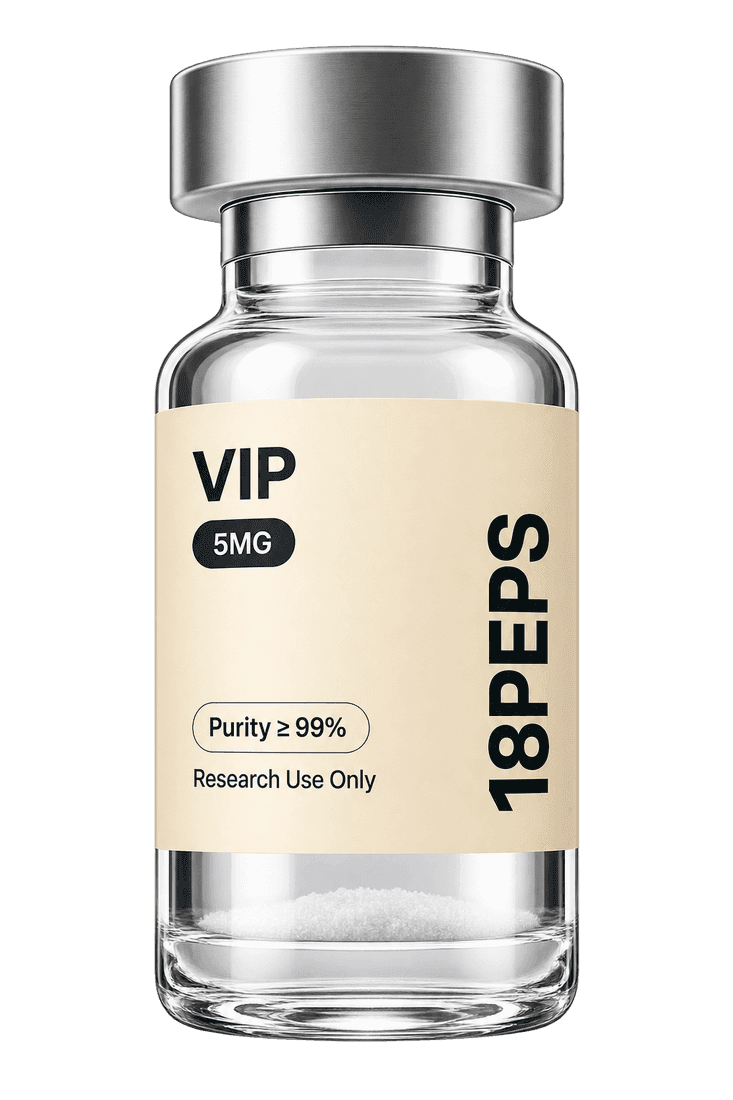
A 28-residue, C-terminally amidated neuropeptide of the secretin/glucagon superfamily and the endogenous agonist at the class B receptors VPAC1 and VPAC2. The synthetic peptide carries the INN aviptadil; its circulating half-life is on the order of one to two minutes.
Vasoactive intestinal peptide is a 28-residue neuropeptide with a C-terminal amide, H-His-Ser-Asp-Ala-Val-Phe-Thr-Asp-Asn-Tyr-Thr-Arg-Leu-Arg-Lys-Gln-Met-Ala-Val-Lys-Lys-Tyr-Leu-Asn-Ser-Ile-Leu-Asn-NH2. It is an endogenous human peptide, not a designed analogue: UniProt P01282 records it as residues 125-152 of a 170-residue precursor, with the terminal asparagine annotated as an amide, and the same precursor also yields the related peptides PHM-27 and PHV-42. The human, porcine and rat sequences are identical, which is why catalogue listings for this peptide typically name all three species. VIP belongs to the secretin/glucagon superfamily alongside PACAP, glucagon and GLP-1, and is characterised as an agonist at two class B G-protein-coupled receptors, VPAC1 (VIPR1) and VPAC2 (VIPR2), both of which couple to Gs and raise intracellular cAMP; it also binds the PACAP-preferring PAC1 receptor with lower affinity. The synthetic peptide is assigned the International Nonproprietary Name aviptadil.
VIP has been characterised in vitro and in animal models in relation to vascular and non-vascular smooth muscle relaxation, intestinal water and electrolyte secretion, and circadian pacemaking in the suprachiasmatic nucleus via VPAC2. Because VPAC1 is expressed on T-lymphocytes, macrophages and dendritic cells, a substantial immunology literature examines VIP as an endogenous modulator of cytokine production and T-cell differentiation. As aviptadil the peptide has entered human medicine: a fixed intracavernosal combination of aviptadil with phentolamine mesilate (Invicorp; each ampoule declared as 25 micrograms aviptadil with 2 mg phentolamine mesilate) holds marketing authorisation in the United Kingdom and has been marketed in Denmark and New Zealand for erectile dysfunction, and has been appraised by the Scottish Medicines Consortium and the All Wales Therapeutics and Toxicology Centre. Inhaled and intravenous aviptadil have separately been investigated in pulmonary arterial hypertension, sarcoidosis and COVID-19-associated respiratory failure. Endogenous VIP is also the measured analyte in the diagnosis of VIPoma (Verner-Morrison syndrome), a rare neuroendocrine tumour defined by pathological VIP hypersecretion.
Two limitations should be read alongside the above. First, pharmacokinetics: intravenous VIP is reported to have a circulating half-life on the order of one to two minutes, being rapidly cleaved by dipeptidyl peptidase-4 and neutral endopeptidase. This is the reason essentially every serious clinical programme has used local injection, inhalation or continuous infusion rather than systemic administration of the unmodified peptide, and it is a substantive obstacle rather than a formulation detail. Second, the largest and best-controlled trial of the molecule was negative. ACTIV-3b/TESICO, a randomised, placebo-controlled trial of intravenous aviptadil in COVID-19-associated hypoxaemic respiratory failure, randomised 471 participants, was halted for futility by its data and safety monitoring board in May 2022, and reported no evidence of benefit on its primary ordinal outcome when published in The Lancet Respiratory Medicine in 2023. Most other supportive human reports for VIP are small, open-label or uncontrolled. The existence of an approved product should not be read across: the licensed indication is a local intracavernosal combination with an alpha-blocker for erectile dysfunction, which establishes nothing about systemic administration of the bare peptide, and the positioning of VIP in the research-chemical market around chronic inflammatory and neuroimmune conditions rests on mechanistic plausibility rather than controlled evidence.
Specification
| CAS number | 40077-57-4 |
|---|---|
| Molecular formula | C147H238N44O42S |
| Molecular weight | 3325.83 g/mol |
| Sequence | H-His-Ser-Asp-Ala-Val-Phe-Thr-Asp-Asn-Tyr-Thr-Arg-Leu-Arg-Lys-Gln-Met-Ala-Val-Lys-Lys-Tyr-Leu-Asn-Ser-Ile-Leu-Asn-NH2 (HSDAVFTDNYTRLRKQMAVKKYLNSILN); C-terminal amide, all L-configuration |
| Appearance | Lyophilised white powder |
| Storage | Store at -20°C, protect from light |
Batch records & certificates
Every lot we hold of this compound, across all warehouses. The certificate is tied to that lot number — not a generic sample document.
| Lot | Warehouse | Purity | Tested | Laboratory | Documents |
|---|---|---|---|---|---|
| VP10-021326 | All warehouses | 99.5% | 19 Feb 2026 | Analytical Formulations Inc. | COA |