TB-500
Acetylated thymosin beta-4 (17–23) fragment
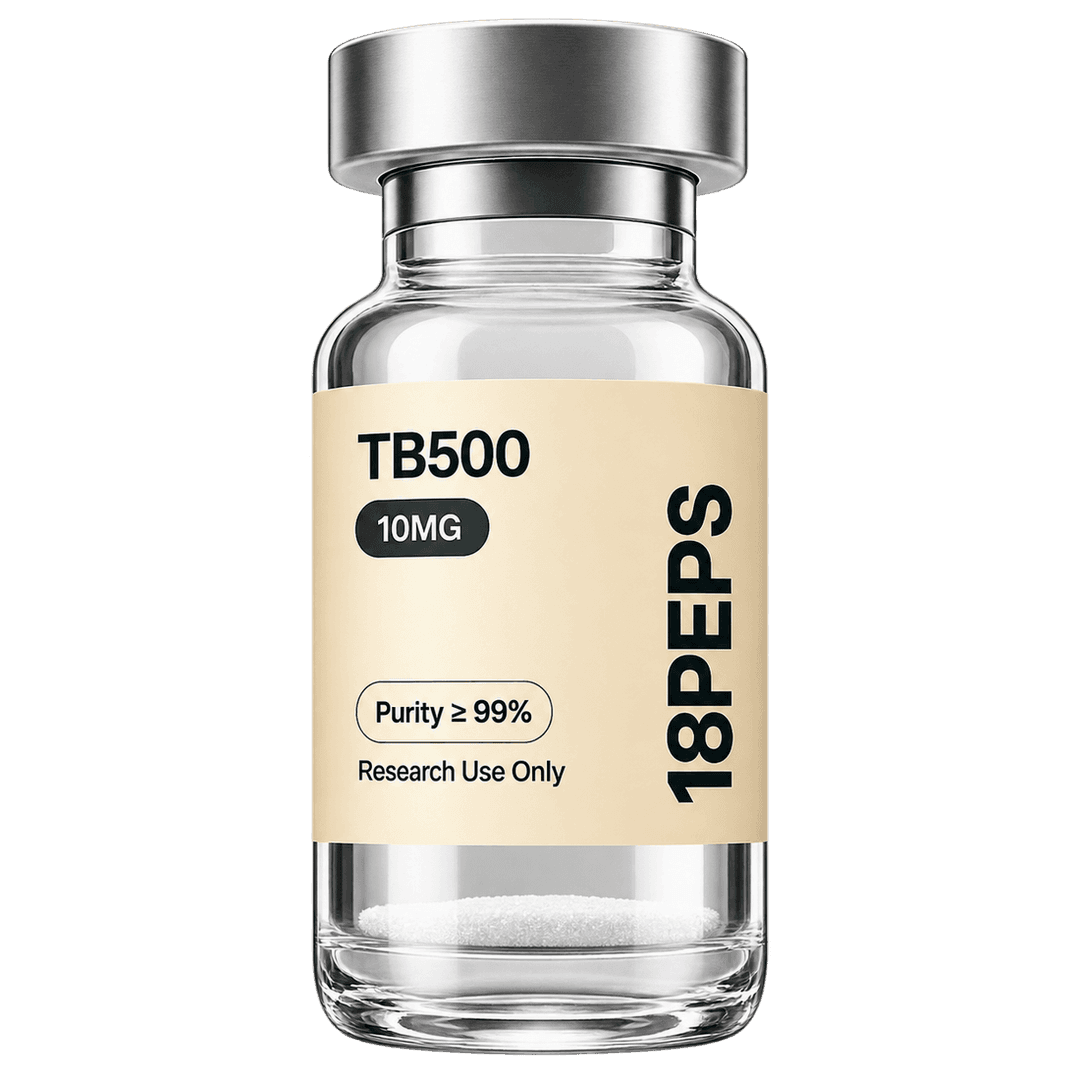
The N-terminally acetylated 17–23 fragment of thymosin beta-4 — a distinct molecule from the full-length 43-residue protein, which we label accurately.
Material sold across this industry as "TB-500" was chemically characterised by Esposito et al. in 2012 and shown to be the acetylated 17–23 fragment of thymosin beta-4 (Ac-LKKTETQ), not the full-length protein. We list it under its accurate description rather than implying it is thymosin beta-4 itself.
This distinction matters when reading the literature: the large body of work on cardiac repair and actin sequestration concerns the full 43-residue protein and cannot be assumed to transfer to this fragment.
Supplied lyophilised. Not approved by any medicines regulator for human use.
Specification
| Purity | ≥98% (HPLC) |
|---|---|
| Sequence | Ac-Leu-Lys-Lys-Thr-Glu-Thr-Gln (Ac-LKKTETQ) |
| Appearance | Lyophilised white powder |
| Storage | Store at -20°C, protect from light |
Batch records & certificates
Every lot we hold of this compound, across all warehouses. The certificate is tied to that lot number — not a generic sample document.
| Lot | Warehouse | Purity | Tested | Laboratory | Documents |
|---|---|---|---|---|---|
| TB25-0207 | India | 98.8% | 2 Jul 2026 | Colmaric Analyticals | COA pending |
| TB25-0193 | United States | 98.7% | 28 Apr 2026 | Janoshik Analytical | COA pending |
Published research
Full research profilePreclinical evidence only
Synthesis and characterization of the N-terminal acetylated 17-23 fragment of thymosin beta 4 identified in TB-500
Analytical chemistry establishing that commercially sold TB-500 is the Ac-LKKTETQ fragment, not full-length thymosin beta-4.
Thymosin beta4 activates integrin-linked kinase and promotes cardiac cell migration, survival and cardiac repair
Full-length thymosin beta-4 improved cardiac function after infarction in mice via integrin-linked kinase and Akt activation. Concerns the full protein, not the TB-500 fragment.
Thymosin β4 significantly improves signs and symptoms of severe dry eye in a phase 2 randomized trial
A phase 2 randomised trial of topical thymosin beta-4 ophthalmic solution in severe dry eye — the furthest the full-length protein has progressed in humans.