How does the SS-31 peptide work? (Elamipretide for Barth syndrome)
Biochemist Rob Swanda on how SS-31 (elamipretide) interacts with cardiolipin in the inner mitochondrial membrane, in the context of Barth syndrome.
We hold stock in three warehouses and price each market separately. Choose yours so we can show you the right prices, the right currency, and only what we can actually ship to you.
You can change your region at any time from the header. Everything we sell is supplied for laboratory research use only.
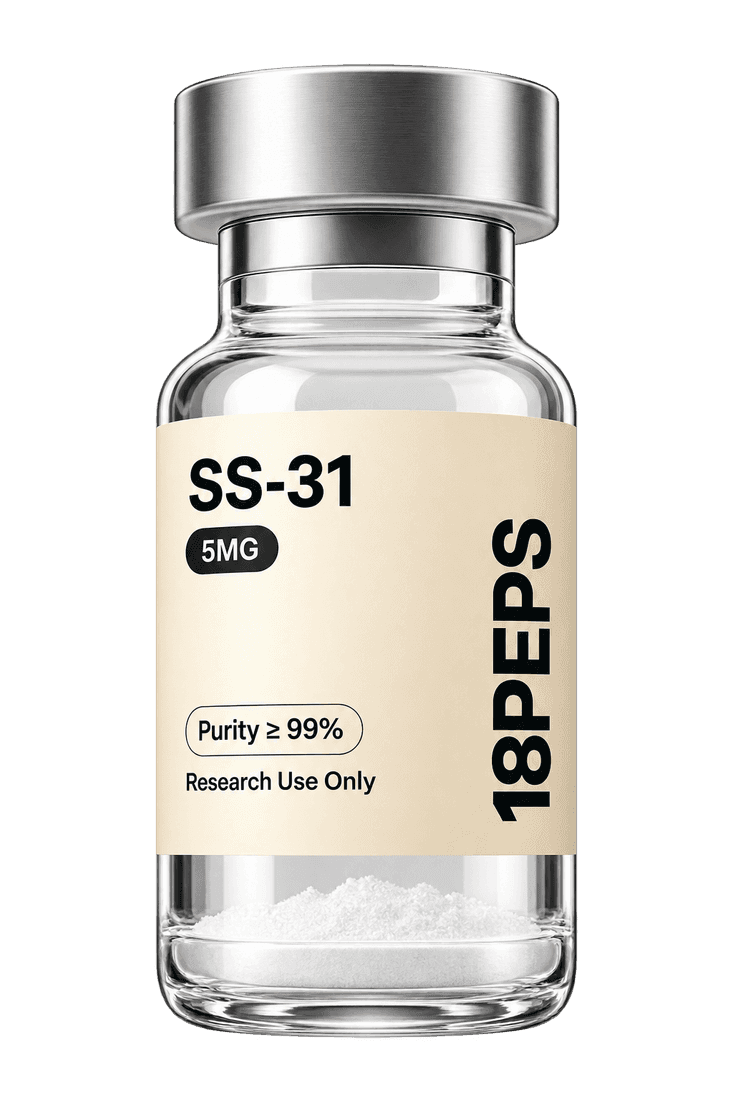
Elamipretide (SS-31) — free base. Chemistry below describes the free base, not the hydrochloride salt.

A mitochondria-targeting aromatic-cationic tetrapeptide from the Szeto-Schiller series that binds cardiolipin in the inner mitochondrial membrane. Approved in the US as elamipretide HCl; research-grade material is not that finished product.
Elamipretide, widely catalogued under its research code SS-31, is a synthetic tetrapeptide with an alternating cationic/aromatic residue pattern. It contains two non-proteinogenic features: a D-arginine at position 1 and the unnatural residue 2',6'-dimethyltyrosine at position 2, with a C-terminal carboxamide. This architecture makes the peptide cell-permeable and allows it to concentrate in the inner mitochondrial membrane in a manner reported to be independent of membrane potential, distinguishing it from cationic mitochondrial probes that depend on the potential gradient.
The molecular target described in the literature is cardiolipin, the signature dimeric phospholipid of the inner mitochondrial membrane. Elamipretide binds cardiolipin reversibly and has been studied for effects on cristae architecture and on the organisation of electron transport chain supercomplexes. It has been investigated in models of ischaemia-reperfusion injury, heart failure, mitochondrial myopathy, and in Barth syndrome, a genetic condition in which tafazzin mutations reduce mature cardiolipin.
On regulatory status: elamipretide hydrochloride received FDA accelerated approval in September 2025 under the trade name Forzinity, making this a genuinely approved medicine in at least one jurisdiction. That approval should be read precisely. It rests on TAZPOWER, a randomised, double-blind, placebo-controlled crossover trial in twelve patients in which the randomised phase did not show the knee-extensor strength increase sought; the observed change came during open-label extension. Accelerated approval is a conditional pathway. Separately, trials in other mitochondrial and cardiac indications have returned mixed results. Research-grade peptide sold here is not the approved finished drug product and has not been through its manufacturing, characterisation or labelling controls.
| CAS number | 736992-21-5 |
|---|---|
| Molecular formula | C32H49N9O5 |
| Molecular weight | 639.8 g/mol |
| Sequence | H-D-Arg-Dmt-Lys-Phe-NH₂ (Dmt = 2',6'-dimethyl-L-tyrosine); C-terminal amide |
| Appearance | Lyophilised white powder |
| Storage | Store at -20°C, protect from light |
Every lot we hold of this compound, across all warehouses. The certificate is tied to that lot number — not a generic sample document.
| Lot | Warehouse | Purity | Tested | Laboratory | Documents |
|---|---|---|---|---|---|
| SS50-0514 | All warehouses | 99.77% | 30 Jul 2026 | Janoshik Analytical | COA |
Biochemist Rob Swanda on how SS-31 (elamipretide) interacts with cardiolipin in the inner mitochondrial membrane, in the context of Barth syndrome.
The videos collected here are published by independent third parties. They are provided as educational context only. We did not produce them, we do not endorse them, and nothing in them constitutes guidance, instruction or encouragement to administer any compound to humans or animals.