N-Acetyl Semax
N-acetylated Semax — ACTH(4-7) heptapeptide with a C-terminal Pro-Gly-Pro tail
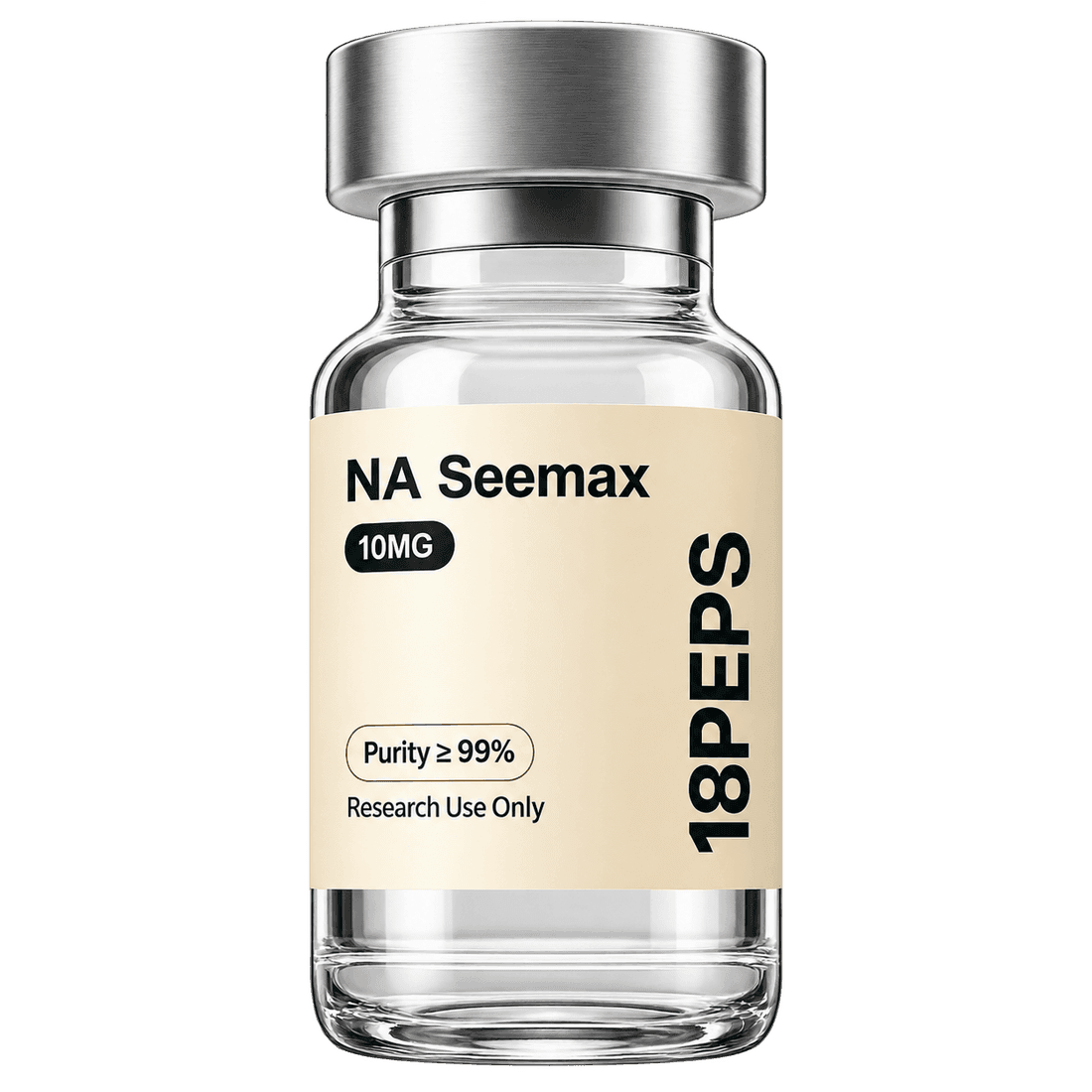
N-acetylated Semax. A synthetic heptapeptide: the ACTH(4-7) fragment Met-Glu-His-Phe extended with Pro-Gly-Pro. Registered as a prescription medicine in Russia; not approved by the FDA, EMA or MHRA. Studied largely in Russian work on ischaemic brain injury and neurotrophin expression.
This is the N-acetylated form of Semax. Acetylation of the free N-terminal amine removes the positively charged alpha-amino group that aminopeptidases recognise, blocking the principal route by which the parent peptide is cleaved. The practical consequence reported for N-acetylated analogues of this family is a longer duration of exposure than the unmodified peptide. The two are distinct chemical entities and should not be treated as interchangeable on a mass-for-mass basis.
Semax is a synthetic heptapeptide built from the adrenocorticotropic hormone fragment ACTH(4-7) — Met-Glu-His-Phe — extended at the C-terminus with the tripeptide Pro-Gly-Pro. The Pro-Gly-Pro tail is a stabilising motif: proline-flanked termini are poor substrates for aminopeptidases, and the extension is there to slow degradation of what is otherwise a very short-lived fragment. Semax is reported to lack the corticotropic and steroidogenic activity of full-length ACTH, since the residues that drive melanocortin receptor binding lie outside the 4-7 window. It was developed at the Institute of Molecular Genetics of the Russian Academy of Sciences and is formulated as an intranasal solution in its Russian medicinal form.
The published work is concentrated on the central nervous system. Rodent studies have examined expression of brain-derived neurotrophic factor and nerve growth factor and their receptors in hippocampus and cortex, markers of the dopaminergic and serotonergic systems, gene expression profiling in ischaemic brain tissue, and infarct volume and neurological scoring in middle cerebral artery occlusion models. Human work, conducted almost entirely in Russia, covers acute ischaemic stroke, transient ischaemic attack, optic nerve disorders and chronic cerebral ischaemia, and Semax is registered in the Russian Federation for several of these indications. A separate strand examines the Pro-Gly-Pro fragment released on metabolism, which has its own reported activity.
The honest limitation is provenance. Almost the entire Semax literature originates from Russian institutions, a large fraction of it in Russian-language journals that are not indexed in MEDLINE or are indexed without English abstracts. The trials supporting Russian registration have generally not been published in a form that lets an outside reader appraise randomisation, blinding, comparator choice or endpoint definition, and independent replication outside Russia is close to absent. No FDA, EMA or MHRA review has ever been completed. The Russian marketing authorisation is a real regulatory fact and is reported as such, but it should not be read as equivalent to an FDA or EMA approval, and the strength of the underlying evidence remains difficult for an outside reader to verify.
Specification
| Molecular formula | C39H53N9O11S |
|---|---|
| Molecular weight | 856.0 g/mol |
| Sequence | Ac-Met-Glu-His-Phe-Pro-Gly-Pro (C-terminus deliberately unspecified — both the free acid and the amidate are traded under this name) |
| Appearance | Lyophilised white powder |
| Storage | Store at -20°C, protect from light |
Batch records & certificates
Every lot we hold of this compound, across all warehouses. The certificate is tied to that lot number — not a generic sample document.
| Lot | Warehouse | Purity | Tested | Laboratory | Documents |
|---|---|---|---|---|---|
| NAXA50-021326 | All warehouses | 99.4% | 19 Feb 2026 | Analytical Formulations Inc. | COA |