KLOW (Blend)
Four-component co-lyophilised blend supplied by 18PEPS as GHK-Cu 50 mg, BPC-157 10 mg, TB-500 10 mg and KPV 10 mg, 80 mg total peptide
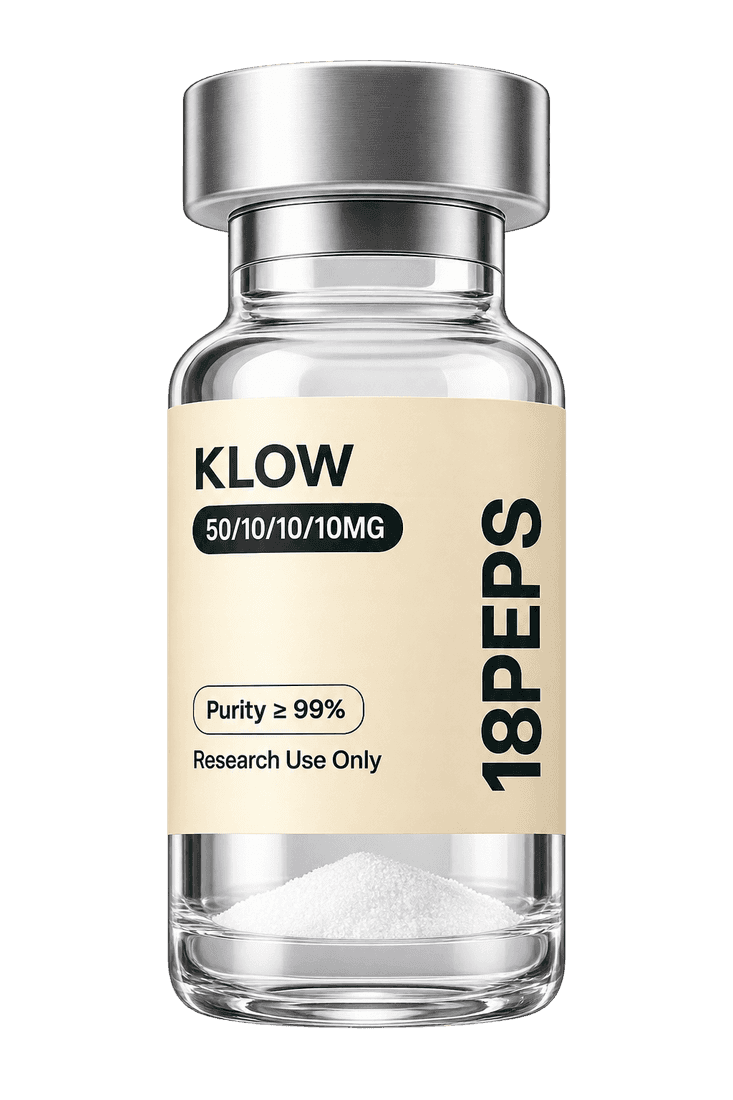
A four-component co-lyophilised blend supplied by 18PEPS as GHK-Cu 50 mg, BPC-157 10 mg, TB-500 10 mg and KPV 10 mg (80 mg total peptide). Composition is supplier-defined rather than standardised, and no blend-level CAS, formula or molecular weight can exist.
KLOW is a mixture, not a single chemical entity, and the composition supplied by 18PEPS is GHK-Cu 50 mg, BPC-157 10 mg, TB-500 10 mg and KPV 10 mg, totalling 80 mg of peptide per vial. The four components are chemically distinct. GHK-Cu is the copper(II) complex of the tripeptide glycyl-L-histidyl-L-lysine; the metal-free tripeptide is C14H24N6O4, 340.38 g/mol (PubChem CID 73587), and the copper complex is catalogued as prezatide copper, C14H23CuN6O4+, 402.92 g/mol (PubChem CID 71587328). BPC-157 is a 15-residue synthetic peptide, H-Gly-Glu-Pro-Pro-Pro-Gly-Lys-Pro-Ala-Asp-Asp-Ala-Gly-Leu-Val-OH (GEPPPGKPADDAGLV), C62H98N16O22, 1419.5 g/mol (PubChem CID 9941957; CAS 137525-51-0). TB-500 is the N-terminally acetylated heptapeptide corresponding to residues 17-23 of thymosin beta-4, Ac-Leu-Lys-Lys-Thr-Glu-Thr-Gln-OH, C38H68N10O14, approximately 889.0 g/mol - it is a fragment carrying the conserved LKKTET actin-binding motif and is NOT full-length thymosin beta-4, a conflation that is common in this market. KPV is the tripeptide Lys-Pro-Val, the C-terminal fragment of alpha-melanocyte-stimulating hormone, C16H30N4O4, 342.43 g/mol (PubChem CID 125672; CAS 67727-97-3).
The four components have separate and largely non-overlapping literatures, and there is no peer-reviewed study of them as a fixed combination. GHK and its copper complex have been examined in vitro in relation to copper transport and extracellular-matrix gene expression, and GHK-Cu is a long-established cosmetic ingredient. BPC-157 has been studied almost entirely in rodent models of gastrointestinal and musculoskeletal injury, with reported interactions with angiogenesis-associated and nitric-oxide-associated signalling; independent human data is absent. TB-500 is studied as a G-actin-sequestering fragment, with much of the cited literature in fact concerning full-length thymosin beta-4 rather than the heptapeptide. KPV has been characterised in vitro and in rodent models of intestinal inflammation in relation to NF-kappaB signalling. Combining four compounds in one vial does not combine their evidence bases; the blend inherits the weakest evidence among its parts, not the strongest.
On naming, one point is worth stating plainly because it is frequently confused. The prevailing convention across current commercial listings is that KLOW is the three-component GLOW blend - GHK-Cu, BPC-157 and TB-500 - with KPV added as a fourth, and 50/10/10/10 in an 80 mg vial is the composition most often listed. On that reading, the composition 18PEPS supplies is the conventional one, and BPC-157 is a standard component rather than a substitution. LL-37, a 37-residue cathelicidin-derived antimicrobial peptide, is a genuinely different molecule that appears in other blends but that I found no evidence for as a standard KLOW component. Beyond naming, the substantive limitations of any blend apply here. No CAS number, molecular formula, molecular weight or sequence can exist for a four-component mixture; those fields are null by definition, not for want of research. There is no reference standard, pharmacopoeial monograph or database record for KLOW, so two vials sold under this name by different suppliers may contain different substances in different proportions. GHK-Cu is a copper(II) coordination complex rather than a plain peptide, and no published data establishes the chemical compatibility or storage stability of a copper complex co-lyophilised with three other peptides in a single vial. Finally, an 80 mg figure denotes total peptide content summed across components; per-component identity and content can only be established from lot-specific HPLC/MS documentation, never inferred from the product name.
Specification
| Appearance | Lyophilised white powder |
|---|---|
| Storage | Store at -20°C, protect from light |
Batch records & certificates
Every lot we hold of this compound, across all warehouses. The certificate is tied to that lot number — not a generic sample document.
| Lot | Warehouse | Purity | Tested | Laboratory | Documents |
|---|---|---|---|---|---|
| KLO-021326 | All warehouses | 99.75% | 17 Feb 2026 | Freedom Diagnostics Testing | COA |