CJC-1295 (DAC)
Long-acting GHRH analogue with drug affinity complex
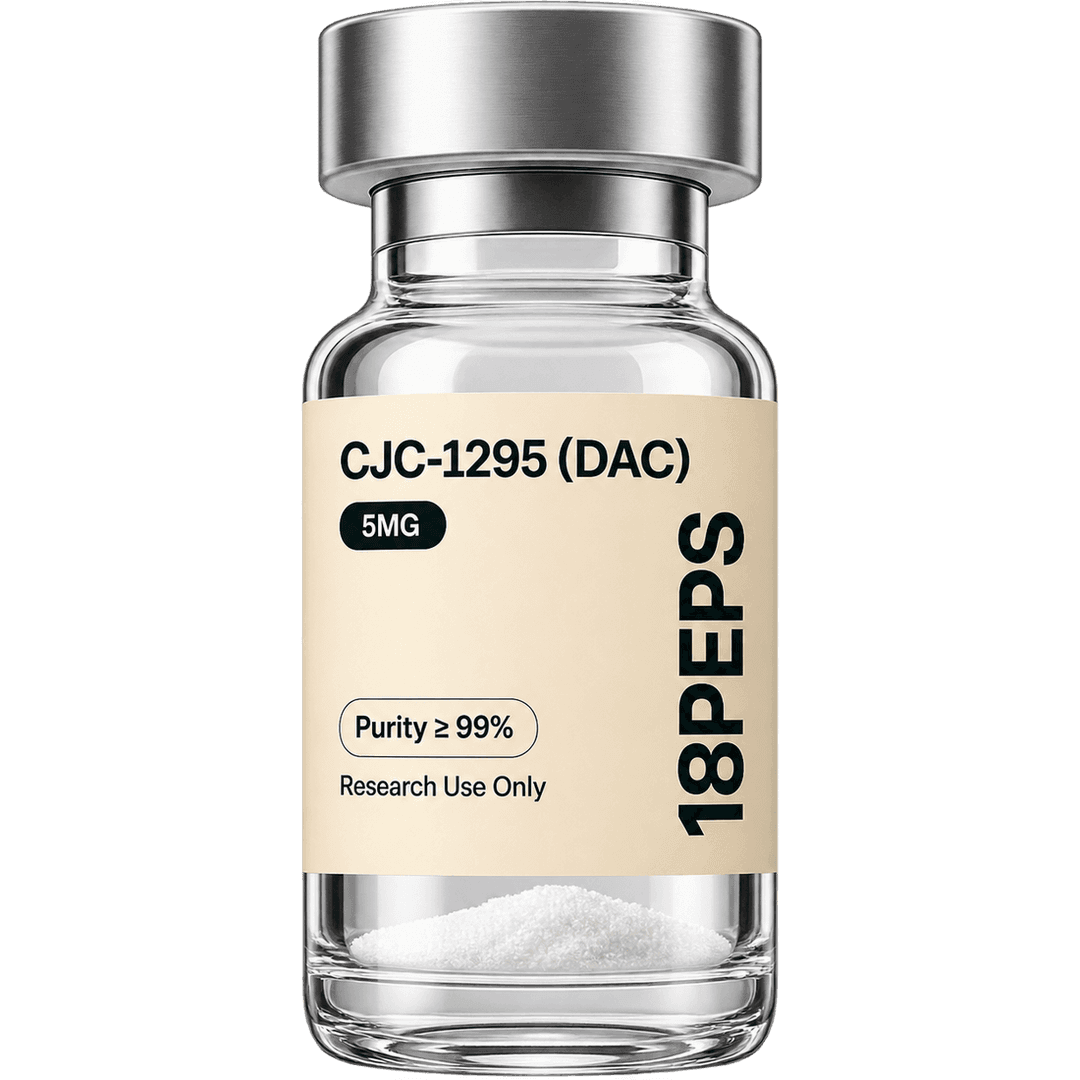
A tetra-substituted GHRH(1-29) analogue bearing an albumin-binding linker, extending half-life from minutes to an estimated 5.8–8.1 days.
CJC-1295 with DAC carries a maleimidopropionyl group at Lys30 that forms a covalent bond with circulating albumin. This is the molecule described by CAS 446262-90-4.
Note that material marketed as "CJC-1295 no-DAC" or "mod GRF 1-29" is a different compound without the linker and does not share this extended half-life. We list them separately rather than conflating them.
Prohibited in sport under WADA rules. Not an approved medicine.
Specification
| CAS number | 446262-90-4 |
|---|---|
| Molecular formula | C165H269N47O46 |
| Molecular weight | 3647.2 g/mol |
| Purity | ≥98% (HPLC) |
| Appearance | Lyophilised white powder |
| Storage | Store at -20°C, protect from light |
Batch records & certificates
Every lot we hold of this compound, across all warehouses. The certificate is tied to that lot number — not a generic sample document.
| Lot | Warehouse | Purity | Tested | Laboratory | Documents |
|---|---|---|---|---|---|
| CJ25-0064 | United States | 98.3% | 19 Mar 2026 | Colmaric Analyticals | COA pending |
Published research
Full research profileIn human clinical trials
Prolonged stimulation of growth hormone (GH) and insulin-like growth factor I secretion by CJC-1295, a long-acting analog of GH-releasing hormone, in healthy adults
Randomised placebo-controlled trials in healthy adults showing sustained elevation of GH and IGF-1 after single doses.
Pulsatile secretion of growth hormone (GH) persists during continuous stimulation by CJC-1295, a long-acting GH-releasing hormone analog
Demonstrated that GH pulsatility is preserved under continuous GHRH-receptor stimulation, with increased pulse amplitude.
Once-daily administration of CJC-1295, a long-acting growth hormone-releasing hormone (GHRH) analog, normalizes growth in the GHRH knockout mouse
Restored normal growth in GHRH knockout mice, supporting receptor-mediated activity in vivo.