Cartalax
L-alanyl-L-glutamyl-L-aspartic acid (Ala-Glu-Asp, AED) — cartilage short peptide bioregulator
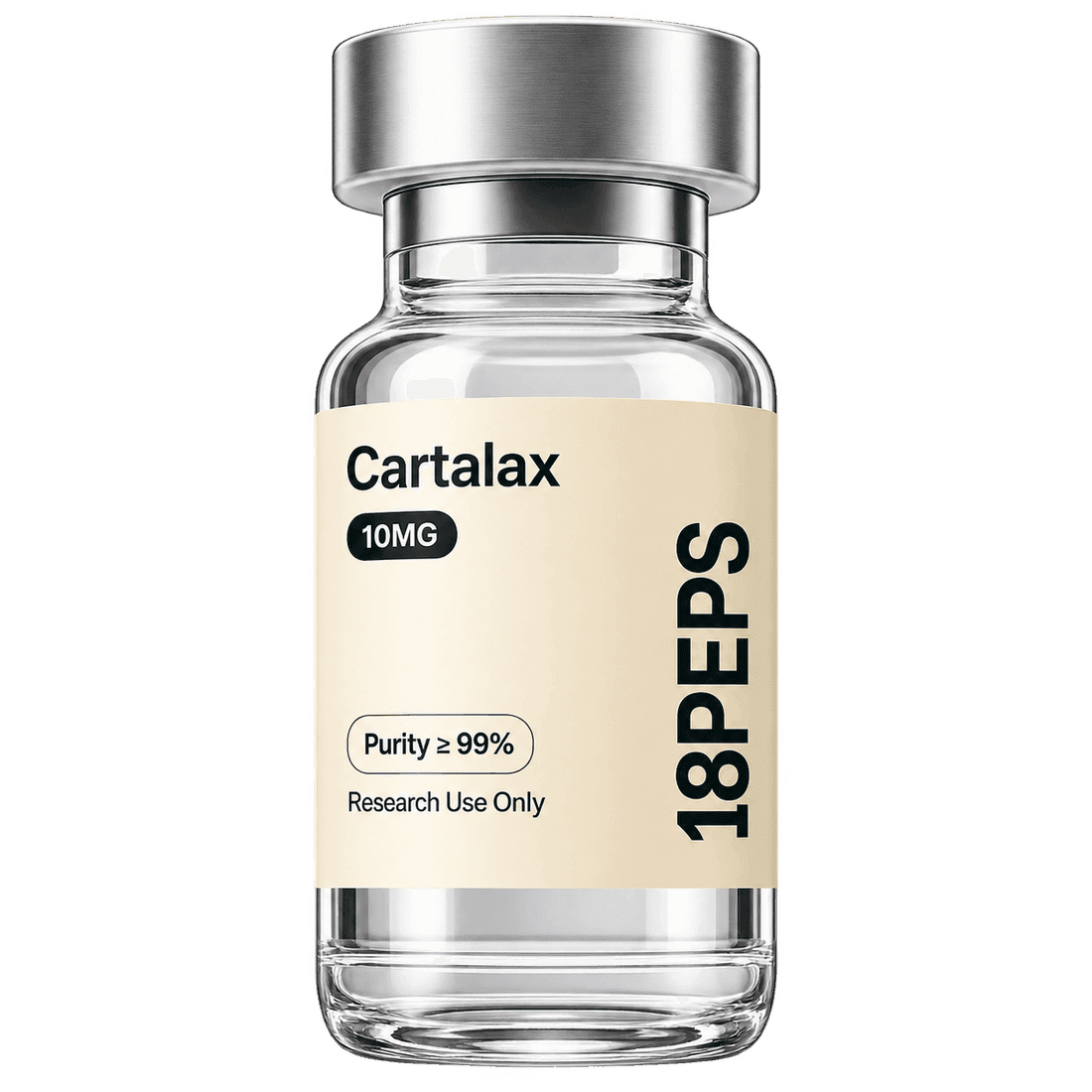
A synthetic tripeptide, Ala-Glu-Asp, assigned to cartilage in the St Petersburg short peptide bioregulator series. Studied in ageing human chondrocyte cultures and in chondrogenic differentiation of mesenchymal stem cells.
Cartalax is the trade name for the synthetic tripeptide L-alanyl-L-glutamyl-L-aspartic acid (Ala-Glu-Asp, AED), the cartilage-directed member of the short peptide bioregulator series from Vladimir Khavinson's group at the St Petersburg Institute of Bioregulation and Gerontology. PubChem CID 87815447 records the all-L free acid as C12H19N3O8, 333.29 g/mol; the IUPAC name confirms an alpha-linked Ala→Glu→Asp backbone with the glutamate side-chain carboxyl free. In the indexed literature the molecule is almost always written as "AED" or "Ala-Glu-Asp" rather than by trade name — the string "Cartalax" returns zero PubMed records, so it should be treated as a commercial designation attached to a well-described chemical entity, not as a name the research literature uses.
AED has been examined mainly in cellular ageing models. Ashapkin, Khavinson, Shilovsky, Linkova and Vanyushin reported in Molecular Biology Reports 2020 that AED, alongside KED and KE, modulated gene expression in replicatively and stationarily aged human mesenchymal stem cell cultures at nanomolar concentrations, with changes reported in IGF1, FOXO1, TERT, TNKS2 and NF-kB (PMID 32399807). It has also been studied in neuronal differentiation of stem cells (PMID 30791821) and in ageing skin fibroblasts (PMID 27259496). Cartilage-specific work by Myakisheva, Linkova, Polyakova and Ryzhak in Advances in Gerontology 2023 examined chondrogenic differentiation markers (SOX9, aggrecan, type II collagen, COMP) in ageing MSC cultures and senescence-associated secretory phenotype markers in ageing chondrocytes.
On the evidence base: the AED tripeptide is one of the better-studied members of the series, appearing in indexed international journals including Molecular Biology Reports and the International Journal of Immunopathology and Pharmacology as well as the Russian-language Advances in Gerontology. The work is nonetheless concentrated in a small number of collaborating groups around the St Petersburg Institute, with substantially overlapping authorship, and the chondrocyte-specific findings have not been independently replicated by unaffiliated laboratories. All of it is cell culture; there are no registered clinical trials and no drug regulator has approved the molecule.
Specification
| Molecular formula | C12H19N3O8 |
|---|---|
| Molecular weight | 333.29 g/mol |
| Sequence | Ala-Glu-Asp (AED), free acid, all L-configuration |
| Appearance | Lyophilised white powder |
| Storage | Store at -20°C, protect from light |
Batch records & certificates
Every lot we hold of this compound, across all warehouses. The certificate is tied to that lot number — not a generic sample document.
| Lot | Warehouse | Purity | Tested | Laboratory | Documents |
|---|---|---|---|---|---|
| CARTA20-082026 | All warehouses | 99.96% | 26 Aug 2026 | Freedom Diagnostics Testing | COA |