How Much 5-Amino-1MQ To Take?
Curious about how much 5-Amino-1MQ to take? In this video, we break down what it does, the right way to take it, and how to stay motivated on your journey.
via Regan ArchibaldMechanism of action
We hold stock in three warehouses and price each market separately. Choose yours so we can show you the right prices, the right currency, and only what we can actually ship to you.
You can change your region at any time from the header. Everything we sell is supplied for laboratory research use only.
5-amino-1-methylquinolinium iodide · small-molecule NNMT inhibitor (not a peptide)
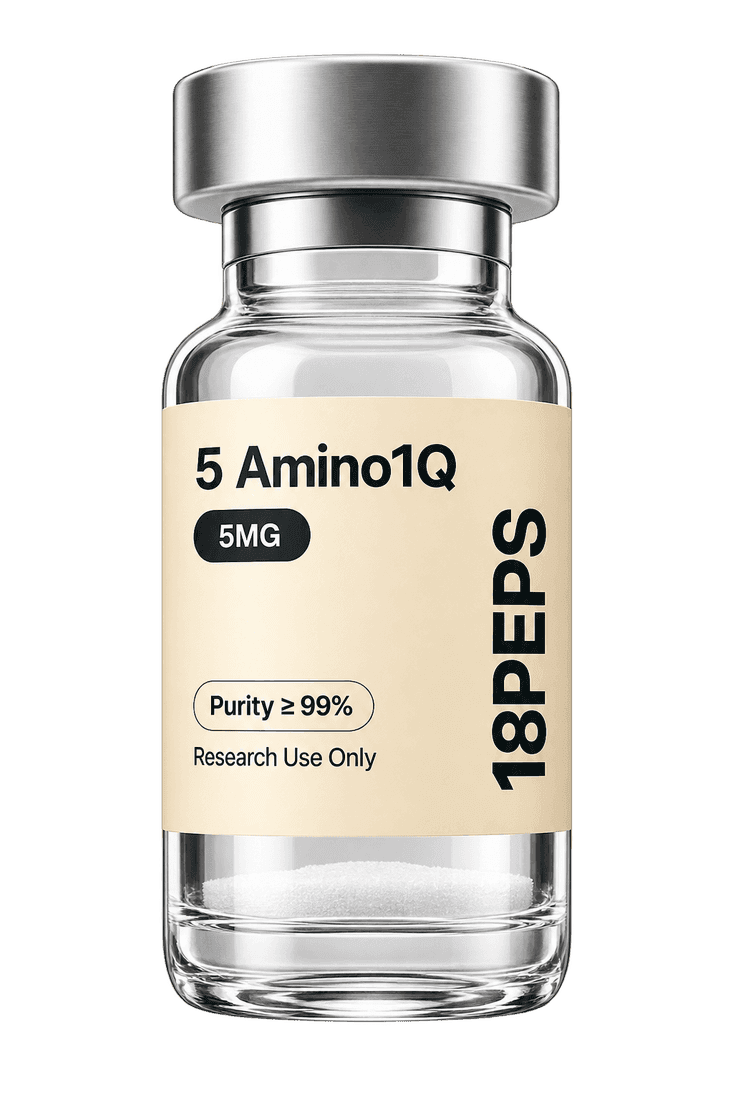
A quaternary quinolinium small molecule and cell-permeable inhibitor of nicotinamide N-methyltransferase (NNMT). Despite being catalogued alongside peptides, it contains no amino acids and is not a peptide.
5-Amino-1MQ is 5-amino-1-methylquinolin-1-ium, a permanently charged quaternary heteroaromatic cation normally supplied as the iodide salt. It is not a peptide and shares no structural relationship with the rest of this category: it is a single fused-ring small molecule of 159 Da as the free cation. Its target is nicotinamide N-methyltransferase, the cytosolic enzyme that transfers a methyl group from S-adenosylmethionine to nicotinamide to yield 1-methylnicotinamide, and the compound acts as a nicotinamide-mimetic, membrane-permeable inhibitor of that reaction.
Because that reaction consumes both nicotinamide, a substrate of the NAD+ salvage pathway, and S-adenosylmethionine, the principal cellular methyl donor, NNMT sits at the junction of NAD+ and methyl-group metabolism; its expression is high in adipose tissue and liver. The best-characterised pharmacological work is Neelakantan et al., 'Selective and membrane-permeable small molecule inhibitors of nicotinamide N-methyltransferase reverse high fat diet-induced obesity in mice', Biochemical Pharmacology, 2018, which reported the design of this inhibitor series and studied it in diet-induced obese mice.
The human evidence base is empty. There are no published human administration studies, and the rodent literature is preclinical proof-of-concept for a target rather than a characterised compound with pharmacokinetic or safety data. The quaternary ammonium centre also matters commercially: the free cation and each of its salts are distinct chemical entities, and the registry number, formula and mass given here describe the iodide specifically.
| CAS number | 42464-96-0 |
|---|---|
| Molecular formula | C10H11IN2 |
| Molecular weight | 286.11 g/mol |
| Purity | ≥99% |
| Appearance | Lyophilised white powder |
| Storage | Store at -20°C, protect from light |
Every lot we hold of this compound, across all warehouses. The certificate is tied to that lot number — not a generic sample document.
Curious about how much 5-Amino-1MQ to take? In this video, we break down what it does, the right way to take it, and how to stay motivated on your journey.
Dr. Dwayne Jackson explains what 5-amino-1-MQ is, how it works, and what current research shows. He describes it as a small molecule that blocks the enzyme NNMT, which helps preserve NAD+ levels and may enhance fat metabolism, muscle regeneration, and anti-aging effects - though all evidence so far comes from rodent studies, not humans. Jackson emphasizes that while early data looks promising, the compound’s safety, efficacy, and long-term effects in humans remain unproven, warning that online anecdotal use is experimental and risky.
The videos collected here are published by independent third parties. They are provided as educational context only. We did not produce them, we do not endorse them, and nothing in them constitutes guidance, instruction or encouragement to administer any compound to humans or animals.